


Do you still love your partner but can’t remember how to communicate without having the same arguments again and again?
Does it feel as though the bond between you and your partner has faded?
Do you find that you avoid opening up to your partner because you just don’t feel that he/she hears what you have to say?
Do you feel alone in your relationship or that your partner doesn’t care about you the way he/she used to?
If you answer yes to any of these questions, Emotionally Focused Therapy (EFT) for couples can help you and your partner change negative patterns for good. Relationships often start with an intense connection but over time the spark that initially attracted you to each other can fade or disappear and often you feel the connection to your partner goes with it. EFT offers a way for couples of all ages to learn how to communicate in ways that bring you closer together by helping you understand negative patterns of communicating, allowing each of you to express thoughts and fears in safe and respectful ways and, finally, helping couples to feel more bonded and close again, or perhaps closer than ever before.
People in happy relationships also tend to enjoy better overall physical health and well-being. Research shows that marital satisfaction has been linked to better immune system functioning, recovery from illness and injury, and helps with the management of stressful situations.
EFT for Clients
Explore options for Individuals, Couples and Families
EFT for Clients
Explore options for Individuals, Couples and Families
The three stages - An Introduction to EFT
1. Recognize Negative Patterns
In the first stage, the focus is on helping couples to better understand the negative patterns of interacting and communicating that they repeatedly get stuck in. In stage one, key goals include helping couples to:
Better understand negative patterns of communication
Better understand what underlying feelings feed into conflict
Experience less conflict
Experience “more space” to begin to talk more deeply about important topics in the relationship
2. Create New Patterns
In the second stage, the focus is on creating new, more effective, and more emotionally satisfying ways of interacting and communicating together. Key goals include:
Helping each partner to see the other in a different, more understanding light
Helping each partner to feel more safe and secure in talking about very important things
Helping couples to feel more bonded and close again, or even closer than they ever have been
Helping couples to feel that sense of specialness and being valued again
3. Clarity and Preparedness
In the third stage, the focus is on building upon the gains that have already been made, and applying them directly to more specific issues within the relationship. Key goals include:
Having a clear sense of the old, negative pattern of interaction and communication.
Having a clear sense of the new, positive ways of interacting
Confidence about having the skills and strategies to help maintain these positive interactions together
Feeling prepared to end therapy with a hopeful outlook for the future
Hold Me Tight: Seven Conversations for a Lifetime of Love

Heralded by the New York Times and Time magazine as the couple therapy with the highest rate of success, Emotionally Focused Therapy works because it views the love relationship as an attachment bond. This idea, once controversial, is now supported by science, and has become widely popular among therapists around the world.
In Hold me Tight, Dr. Sue Johnson presents Emotionally Focused Therapy to the general public for the first time. Johnson teaches that the way to save and enrich a relationship is to reestablish safe emotional connection and preserve the attachment bond. With this in mind, she focuses on key moments in a relationship-from Recognizing the Demon Dialogue to Revisiting a Rocky Moment-and uses them as touchpoints for seven healing conversations. Through case studies from her practice, illuminating advice, and practical exercises, couples will learn how to nurture their relationships and ensure a lifetime of love.

EFT for Therapists
EFT for Therapists
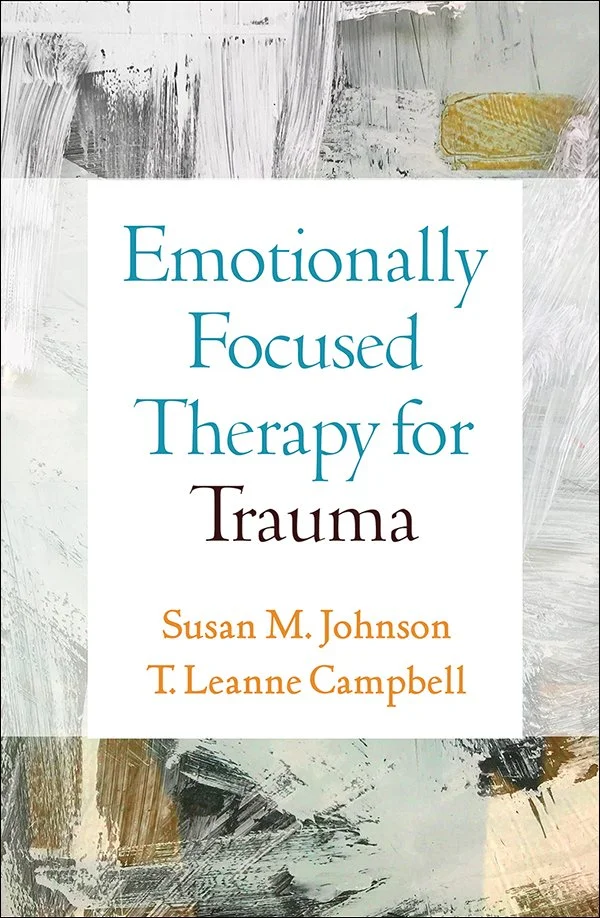
Emotionally Focused Therapy for Trauma
by Susan M. Johnson, T. Leanne Campbell
This innovative clinician’s guide shows how emotionally focused therapy (EFT) is ideally suited to target core elements of recovery from common impacts of chronic, cumulative, or acute trauma. EFT pioneer Susan M. Johnson and her collaborator and leading EFT trainer T. Leanne Campbell provide a clear intervention framework and numerous vivid clinical examples illustrating their attachment-informed, experiential approach. Using dance—in particular, the tango—as a metaphor for what happens in session, the book takes therapists move by move through the three stages of EFT with individuals or couples affected by the echoes of trauma. Chapters conclude with reflection questions, learning exercises, and recaps of key ideas, enhancing the volume’s practical utility.
EFT World Summit
Growing Through Connection
Vancouver, Canada – May 9-11, 2027
Join colleagues from around the world for two days of keynotes, hands-on workshops, clinical dialogue and panel discussions with leading voices in Emotionally Focused Therapy and attachment science. You will sharpen practical skills, learn interventions you can use immediately, and build professional connections that strengthen your clinical work long after the Summit ends. Fun and connection begin the evening of May 9th with entertainment and informal networking. CE credits will soon be available for all Summit sessions.